Showing posts with label democracy. Show all posts

Wednesday, May 28, 2008

Dirty Rascals No Longer in the Castles


In my attempt to include more regional variation on this blog, I'd like to talk about Nepal as it was such a nice front page news item on news.bbc.co.uk.

I really don't know anything about Nepal, and frequently get it confused with Tibet and the Dalai Llama. But now, I get to learn new things about old places.

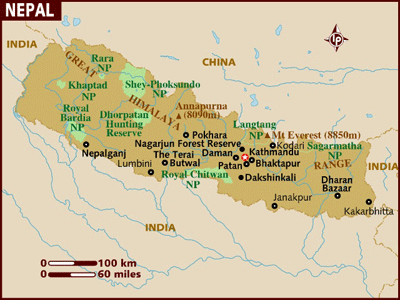
As you can see from the map above, Nepal is a little country in between China and India which immediately drove me to the assumption that there are probably many different ethnic groups and some amazing food.

Nepal has been under a monarchy for most of its history. The current ruling family has been in power since the 1950's. Sometimes, monarchies are benign. Their power is limited and they play a largely ceremonial role. Not the case with Nepal, unfortunately. It is among the poorest countries of the world.

In the 1950's and 60's, a parliamentary democracy existed as sort of an experiment. King Mahendra ended that experiment, calling it a failure, and re-establishing the monarchy. But the resistance to absolute rule grew, and finally, a multiparty parliament was put in place in 1990.

In 2001, there a disturbing event took place when the crown prince Dipendra killed 11 members of the royal family, including the king and queen, and then turned the gun on himself. He briefly survived his wounds, and in that time, he became king. The current King Gyanendra, Dipendra's brother, was crowned once Dipendra died.

Failing to negotiate with Maoist rebels in the country, Gyanendra sacked the government and took complete control in 2005. Direct palace rule was ended in 2006 and just today, the government declared it will abolish the monarchy.

Woohoo!
"The newly installed Maoist-led government says that after vacating the royal palace - which along with other royal properties will be nationalised - he will be free to carry on living in Nepal as an ordinary tax paying citizen and will not be forced into exile.

That is the final humiliation for a monarch who over the last few years has been removed as head of the army and lost nearly all his staff.

In addition he has suffered the indignities of having his allowances cut by parliament and his face removed from the country's currency."


That is very nonviolent and totally awesome. It hasn't been a completely nonviolent revolution, and people are still fighting about what kind of democracy it will be, but I say its a good start.

Yay Nepal!

Thursday, January 24, 2008

Sycophantism and Waziristan "Part Deux"

Soon to come on this blog, more discussion of religion and destruction as I am writing a short paper about it this week. It should be fun. In the meantime, enjoy more discussion of my awesome professor.

Here's a quote from Dr. Ahmed's interview with The Globalist Part II where he answers a question about Waziristan and modernity. The answer I think is applicable to many societies who have said they have no wish to modernize.


"However the people of Waziristan living in Karachi are as modern as you and me. But back home in their own region, they preserve their own custom and tradition. It is a conscious choice—and has nothing to do with “barbarians living in caves.” They opted for preserving their identity and a culture. They said this preserves our freedom. That’s what they treasured above all. They said, “We have seen what you have done to Pakistan, what modernization means to Pakistan — corrupt police, corrupt revenue officials, corrupt politicians.’ So they said, ‘We have seen all this. What are you going to give us that is different? Why do you want to modernize us? Leave us alone.’"


Also described in the article is how the war on terror has pushed different governments into becoming military states leaving huge vacuums of power open to radicals like the Taliban to step in and "restore" a sense of law and order that is governed by at the very least civilians, if not with the complete blessings of the entire society.

Dr. Ahmed goes on to say that there is indeed a way to bring stability back to Waziristan, but its a tricky one that involves engaging a tribal system rather than abolishing it:

"...The Americans, who seem to be on the war path if newspaper reports are to be taken seriously, have no idea of this type of [tribal] administration. It is a colonial administration and Americans are not a very colonial people. The Americans are used to a mayor who is elected for a fixed period.

In Waziristan, when I was the political agent, I was accountable to no one, except for my own reputation. That is not a very acceptable concept in the West. A 21st century solution has therefore to be found which is informed by the past in which diplomacy and a shrewd understanding of the nature of tribal society often averted death and destruction while meeting the objective at hand."

Friday, January 18, 2008

George Michael and Democracy


So I was reading the nice little bit from The Economist, and lo and behold, I found it to be talking about the same sort of issues I brought up in my Cabaret-esque post. The article is mainly a skeptical look at Freedom House and its inherent US bias, but it also challenges their ideas of "free", "partly free", and "free".

As you can see from the image above, there are many countries that became free from 1982 to 2007, but there are just many that went completely backwards in their freedom ratings. My theory on why that is, The Cold War and its aftermath, oil politics, and then finally the war on terror. There are probably other factors involved as well in the various countries, but those I think are the most shared reasons.

So the really really interesting bit I wanted to point out from it is this:

"How much freer do people feel when they have a few roubles or yuan in their pocket (and access to other goodies like computers and compact discs)? That is an endlessly debatable question. By contrast the sort of liberties and non-liberties measured by Freedom House (multi-party elections, due process and so on) are relatively tangible and easy to assess. That alone may be quite a good argument for having at least one index whose stated purpose is to assess formal freedoms—to vote, speak, assemble and so on. That does not imply that other factors, such as prosperity, have no bearing on how free people feel."


Like the good constructivist I am, I like to focus a lot on how people feel, and so the importance of how free populations feel is paramount. Its whether or not these feelings match up with empirical definitions of the democratic system is the really question, at least for me. China is a great example, and one the article mentions as well. It is poorly ranked for civil liberties, yet its a pretty stable and prosperous country.

You may have discovered at the end of this post that I have deconstructed a particular set of ideas, but I'm not really sure what to construct in their place. Well, I'll figure it out soon enough.

Take a moment, think about it, listen to this wonderful little 90's ditty about Freedom from George Michael, and then make a comment.

Tuesday, January 15, 2008

Money, money, money...


I just read an article on Time.com that talks about the inverse relationship of oil wealth and democracy, citing Bush's visit to the UAE as the latest example. In the Emirates, Sheikh Khalifa bin Zayed al Nahyan dropped some srrrious bling on Dubya. (That's right, I went there). Anyone who's been to the UAE, like me for not an example, can also testify to the decadence of the place.

"It may now be possible to propose a corollary theory: countries that greet American presidents with the gaudiest displays of oil wealth tend to be the least democratic. In Abu Dhabi, Sheikh Khalifa bin Zayed presented Bush with an obscene necklace consisting of a number of increasingly large solid gold stars encrusted with scores of diamonds, rubies and emeralds. Though Bush talked up his "Freedom Agenda" there, his aides dodged questions about the fact that 50% of the country's parliament is appointed by Sheikh Khalifa, who is also the lifetime "President." Saudi Arabia, the most repressive of all the countries Bush visited on his trip, tried to outdo the "President Sheikh" Monday evening with a jewel-laden gold medallion dangling from a chain encrusted with rubies and emeralds."


However, as the article goes on, this isn't to say that all countries with oil resources are doomed. Its only when oil dominates a state's economy that the correlation becomes stronger.

So my interesting thought of the day, reminscent of an earlier post I made about Russia, if populations feel that they are economically better off, who cares what kind of government is in power? I don't know too much about any democratic movements in UAE, but from all outside appearances, everyone seems fairly happy. I'm not saying authoritarianism is acceptable if your people are richer than before, I'm just musing on how relevant Fosse is in this particular area of foreign policy.

Watch this video with Liza Minelli and Joel Gray singing the song "Money" from Cabaret. Maybe you'll start singing it at your next international development class.

Zakaria, Newsweek Editor and Psychic?


Yesterday, I posted about democracy and American strategic interests, and lucky me, Fareed Zakaria touched on the exact same subject that night on A Daily Show. He and Jon Stewart got into a nice little discussion on Pervez Musharraf and how at one point Musharraf was a fairly benign dictator, but haw now developed a Messiah complex. Mr. Zakaria then said the following:

I'm suggesting we like democracy in strategically irrelevant countries.


Such strategically irrelevant countries do not include Pakistan, Egypt, or Saudi Arabia.

Glad to see Mr. Zakaria has been reading my blog...or even my mind. DUN DUN DUN!

I think its more likely he reads my mind. =-P

Monday, January 14, 2008

Ssshhh!

Bush is in Saudi Arabia as part of his tour of the Middle East, spreading democratic good will and the like.

Because I don't think its the American president's job to spread democracy, I can't fault Bush for not talking about politics with his Saudi buddies. However, it still remains a highly hypocritical situation. With so much money at stake, it just makes good business sense to be hypocritical. So whose job is it to spread democracy? First and foremost, it is the job of the population in question. Second, it is the job of the international community, including NGO's, to help these populations achieve their goals if they do not have the resources to meet it themselves.

And so I come to my next point, foreign aid. After taking a class entitled Global Poverty and Peace, I decided that governments giving aid for "democratic" movements in foreign states is a bad idea. The American government has historically proven that democracy isn't as important as strategic interests, and so the aid given in many countries is usually seen with immense skepticism and resent. Best example, Operation Ajax in Iran. The spectre of American involvement in that operation is still very fresh in the minds of the Iranians, and similar events have happened all over the Middle East.

The new movie Charlie Wilson's War touches on the subject of American involvement in the creation of the Taliban. I'm not going to see the movie, but its also another good example.

My conclusion is, the American government should just shut up. Not the American people, but the government.

I don't think I'm likely to get a job at the state department anytime soon. What do you think?

Thursday, January 10, 2008

Bush's Wild on the Middle East Tour...some issues


I just read a great article in Time about Bush's Middle East tour and why many Arabs are skeptical of his urges for peace. The article describes the exact sorts of concerns I have with Bush's visit.

1. Helping the Palestinians....
Arabs cynically see Bush's endorsement of Palestinian statehood as part of the White House's effort to win Arab support at the time for the 2003 invasion of Iraq. Arabs note that until 2007, Bush shunned active Arab-Israeli mediation; he had refused to deal with Arafat, even though he was the elected president of the Palestinian people (as well as the symbolic leader of the Palestinian revolution), and still refuses to deal with the Islamist Hamas group, which won the 2006 Palestinian parliamentary elections. Even though Bush calls the November Annapolis peace conference a "major breakthrough" and says he's an "optimistic guy" about the chances of an Israeli-Palestinian peace agreement by 2009, he refuses to lay out his administration's vision of a fair final settlement — something many experts see as an essential diplomatic step in breaking the long impasse between the parties. As Arabs see it, Bush's failure over the last seven years to exercise decisive U.S. influence over Israel, a close American ally, has simply enabled the Jewish state to expand its settlements throughout the occupied West Bank and made a viable Palestinian state much harder to achieve.


I too am pessimistic about what an independent Palestinian state would look like given the current occupation, as yesterday's post can attest to.

2. Promoting democracy. There are certainly people in Iraq, Lebanon and a few pockets here and there who are grateful for Bush's call for liberty in the Middle East. The problem is that it is widely seen as being insincere at best and hypocritical at worst. Few doubt that toppling Saddam Hussein's dictatorship was more about breaking Arab military strength and projecting American strategic power than fighting terrorism, much less creating Iraqi democracy. While Iraq is no longer a one-man show, it will be a very long time before anyone considers the country, now dominated by Shi'ite Muslim gangs, Kurdish warlords and Sunni terrorists, emblematic of an emerging democracy.
If the Iraq war was about Bush's freedom agenda, Arabs wonder, why has the White House stood by so quietly as pro-American authoritarian Arab regimes have jailed democracy activists, as happened to former presidential candidate Ayman Nour in Egypt? The White House stresses Bush's admiration for Saudi King Abdullah bin Abdulaziz and the country's baby-step municipal elections in 2005, yet Washington is silent about the systematic repression of women and minorities permitted in the name of religion in the Kingdom.


Yes! And don't forget the American support for Musharraf, though not Arab, is Muslim, and embodies the tendency of the US to support dictators in exchange for loyalty to the "war on terror".

3. Confronting Iran. The Arabs are afraid of Iran, especially the Saudis and the emirs who rule the small oil-rich states situated just across the Gulf from the Persian giant. They are inclined to agree with Bush's worries about Iran's nuclear intentions. But they are even more concerned about another U.S. war in the Gulf-this time against Iran, to wipe out its nuclear program. That could bring a swift backlash, either through direct Iranian military retaliation against Washington's regional allies, or in the form of fomenting long-term political unrest and terrorism among Shi'ite minorities in those countries.
Arabs were relieved when the recent National Intelligence Estimate on Iran said that the Islamic regime had shelved its nuclear weapons program in 2003. But a major aim of Bush's tour is to rally Gulf Arabs into an anti-Iran bloc bent on further isolating Tehran diplomatically and economically, without giving up the option of a military attack on Iran, on the grounds that Iran remains a dire threat to regional security. To such logic, Gulf leaders are tempted to reply, "Duh, it was your ousting of Saddam Hussein's regime that enabled Iran to expand its influence in the first place." Arabs would never want Washington to get too cozy with Tehran. But they've had enough Texas gun slinging.


Like duh,gag me with nuclear warhead, Iran totally benefitted from the Iraq war.

Sorry, that was uncalled for.

Yay Time!

Monday, January 7, 2008

The Danger Continues


The latest edition of The Economist has explored the question of Pakistan as the most dangerous nation in the same way Newsweek did a few months ago. The opinion piece, The World's Most Dangerous Place, does good to recognize that the threat of Islamic extremism in Pakistan is a relatively new crisis. One need only look at the ideas of Mr. Jinnah, the founding father of Pakistan, to see the kind of progressive movements and ideas that have come forth in the country.

In contrast to the Newsweek article, the focus of this piece seems to point to Pakistan as a dangerous nation to its people instead of as a danger to American interests. Like Lamis Andoni's blog response on Post Global, the article also points to how external forces have also contributed to Pakistan's instability.

So, ironically, America's support for Mr Musharraf, justified as necessary to combat extremism next door, has fostered extremism at home. Similarly, in the 1980s America backed General Zia ul Haq, a dictator and Islamic fundamentalist, as his intelligence services sponsored the mujahideen who eventually toppled the Soviet-backed regime in Afghanistan. In the process, they helped create what Miss Bhutto called a “Frankenstein's monster”—of jihadist groups with sympathisers in the army and intelligence services. The clubbable, whisky-quaffing, poodle-cuddling Mr Musharraf is no fundamentalist. But the monster still stalks his security forces.


Happily, the author does offer a bright spot, seeing a solution to all the crises.

Yet Pakistan's plight is not yet hopeless. Two things could still help arrest its slide into anarchy, improbable though both now seem. The first is a credible investigation into Miss Bhutto's murder and the security-service lapses (or connivance) that allowed it to happen. Mr Musharraf's willingness to let a couple of British policemen help the inquiry is unlikely to produce this. Every time a bomb goes off in Pakistan, people believe that one of the country's own spooks lit the fuse. Until there has been a convincing purge of the military-intelligence apparatus, Pakistan will never know true stability.

Second, there could be a fair election. This would expose the weakness of the Islamist parties. In the last general election in 2002, they won just one-tenth of the votes, despite outrageous rigging that favoured them. Even if they fared somewhat better this time, they would still, in the most populous provinces, Sindh and Punjab, be trounced by the mainstream parties. An elected government with popular support would be better placed to work with the moderate, secular, professional tendency in the army to tackle extremism and bring Pakistan's poor the economic development they need.


And the final awesome conclusion.

Sadly, there seems little hope that the security forces will abandon the habit of a lifetime and allow truly fair elections. The delay in the voting—opposed by both main opposition parties—has been seen as part of its plan to rig the results. The violence that has scarred the country since Miss Bhutto's assassination may intensify. The army may be tempted to impose another state of emergency; or it may cling on to ensure that the election produces the result it wants—a weak and pliable coalition of the PPP and Mr Musharraf's loyalists.

For too long, Mr Musharraf has been allowed to pay lip-service to democratic forms, while the United States has winked at his blatant disdain for the substance. The justification has been the pre-eminent importance of “stability” in the world's most dangerous place. It is time to impress upon him and the generals still propping him up that democracy is not the alternative to stability. It is Pakistan's only hope.

Thursday, December 27, 2007

Benazir's Life: Part I


Who was Benazir Bhutto? Part I

Mrs. Bhutto was the first woman elected to lead a Muslim state. She was elected to the office of Prime Minister of Pakistan twice, the first time in 1988 and then again in 1996.

She came from a very prestigious and political family. Her father, Zulfikar Ali Bhutto, was the President of Pakistan from 1971 to 1973 and the Prime Minister from 1973 to 1977. Zulfikar was executed in 1979 under the leadership of General Zia ul Haq for the charge of attempted murder.

She was educated at both Radcliffe and Harvard.

Time.com remarks that her political career was marked by "great populist spectacles and little governmental achievement". The article goes on:

However, in the final analysis, her career was an almost tawdry cycle of exile, house arrest, ascent into power and dismissal, much sound and fury and signifying little. Jailed and then exiled after her father's fall, Bhutto returned to campaign for office in 1986 after Zia's military government gave in to international pressure to slowly restore democracy. (Despite his dictatorship, Zia was a key ally of the West, supporting the Mujaheddin against the Soviet occupation of Afghanistan.)...

Zia's death in a plane crash in August 1988 helped to further loosen the military strictures around the country, and Bhutto became Prime Minister by December of that year. As a ruler, Bhutto got few favorable reviews in Pakistan. Her government passed no legislation except a budget during its first 14 months in power. Much of its energy was squandered feuding with the opposition. Among the first acts of Bhutto's party after coming to power was a campaign to bribe and threaten legislators in Punjab. The goal: to overthrow Bhutto's nemesis, Mian Nawaz Sharif, Punjab's chief minister, a wealthy industrialist and a close associate of Zia's. Worse yet, her Cabinet stank with corruption scandals, including allegations against her husband Asif Ali Zardari and her father-in-law Hakim Ali Zardari, who was chairman of the parliamentary public-accounts committee. With so much fractiousness and scandal, Bhutto's first government lasted only until August 1990, dismissed by the country's president for "horse-trading for personal gain." Soon after, in November 1990, Nawaz Sharif, campaigning on an anti-corruption platform, became Prime Minister.

Bhutto returned to power in 1993, after Sharif was felled by his own corruption scandal. "This is my victory. It is a clear and decisive victory," she declared after a bitter name-calling campaign between herself and Sharif. But despite her claims, she did not have a working majority in parliament and had to wobble through her next few years in office as head of a fractious coalition, beholden to contentious blocs of power. At the same time, Pakistan owed huge amounts to the International Monetary Fund as part of servicing its enormous $28.6 billion in foreign debts. Bhutto had raised taxes, which raised the level of discontent in the country. But even so, her government did not collect enough revenue. In an effort to appease the IMF, Bhutto gave up the finance portfolio she had held since retaking the government. "The debt servicing is breaking our backs — debt that I didn't incur," she told TIME. "But as Prime Minister, I have to pay it back." Rumors soon spread that her government would be dismissed. "Rubbish," she said. But that is exactly what happened. Soon, Nawaz Sharif was Prime Minister again.


What's this about corruption charges?

From the BBC's obituary for Mrs. Bhutto, her husband, Asif Zardari, was accused of stealing millions from the state. Many speculated that the downfall of her government was the alleged greed of her husband. Even though none of the 18 charges against him could be proved over the 10 years spent in court, he nonetheless spent 8 years in prison.

Mrs. Bhutto herself was charged with 5 corruption cases, none of which she was ever convicted, and finally amnestied in October 2007. She was convicted, however, of failing to appear before the Supreme Court in 1999, but this conviction was later overturned.

Soon after the conviction, audiotapes of conversations between the judge and some top aides of then Prime Minister Nawaz Sharif were discovered that showed that the judge had been under pressure to convict.


Ms Bhutto left Pakistan in 1999 to live abroad, but questions about her and her husband's wealth continued to dog her.

She appealed against a conviction in the Swiss courts for money-laundering.

During her years outside Pakistan, Ms Bhutto lived with her three children in Dubai, where she was joined by her husband after he was freed in 2004.


What's up with all the deaths in her family?

As mentioned above, her father was executed in 1979. But her two brothers, Murtaza and Shahnawaz, were also assasinated. BBC reports:

Her brother, Murtaza - who was once expected to play the role of party leader - fled to the then-communist Afghanistan after his father's fall.

From there, and various Middle Eastern capitals, he mounted a campaign against Pakistan's military government with a militant group called al-Zulfikar.

He won elections from exile in 1993 and became a provincial legislator, returning home soon afterwards, only to be shot dead under mysterious circumstances in 1996.

Benazir's other brother, Shahnawaz - also politically active but in less violent ways than Murtaza - was found dead in his French Riviera apartment in 1985.