Showing posts with label green revolution. Show all posts

Wednesday, May 28, 2008

Dirty Rascals No Longer in the Castles


In my attempt to include more regional variation on this blog, I'd like to talk about Nepal as it was such a nice front page news item on news.bbc.co.uk.

I really don't know anything about Nepal, and frequently get it confused with Tibet and the Dalai Llama. But now, I get to learn new things about old places.

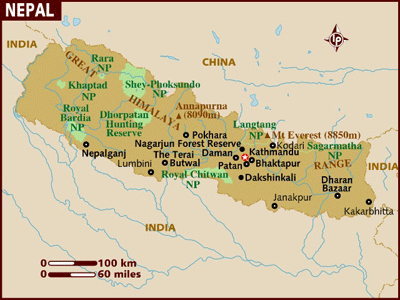
As you can see from the map above, Nepal is a little country in between China and India which immediately drove me to the assumption that there are probably many different ethnic groups and some amazing food.

Nepal has been under a monarchy for most of its history. The current ruling family has been in power since the 1950's. Sometimes, monarchies are benign. Their power is limited and they play a largely ceremonial role. Not the case with Nepal, unfortunately. It is among the poorest countries of the world.

In the 1950's and 60's, a parliamentary democracy existed as sort of an experiment. King Mahendra ended that experiment, calling it a failure, and re-establishing the monarchy. But the resistance to absolute rule grew, and finally, a multiparty parliament was put in place in 1990.

In 2001, there a disturbing event took place when the crown prince Dipendra killed 11 members of the royal family, including the king and queen, and then turned the gun on himself. He briefly survived his wounds, and in that time, he became king. The current King Gyanendra, Dipendra's brother, was crowned once Dipendra died.

Failing to negotiate with Maoist rebels in the country, Gyanendra sacked the government and took complete control in 2005. Direct palace rule was ended in 2006 and just today, the government declared it will abolish the monarchy.

Woohoo!
"The newly installed Maoist-led government says that after vacating the royal palace - which along with other royal properties will be nationalised - he will be free to carry on living in Nepal as an ordinary tax paying citizen and will not be forced into exile.

That is the final humiliation for a monarch who over the last few years has been removed as head of the army and lost nearly all his staff.

In addition he has suffered the indignities of having his allowances cut by parliament and his face removed from the country's currency."


That is very nonviolent and totally awesome. It hasn't been a completely nonviolent revolution, and people are still fighting about what kind of democracy it will be, but I say its a good start.

Yay Nepal!

Wednesday, May 21, 2008

Puns About Green Money and the Green Lifestyle


A few days ago, I was on the bus and this guy sitting next to me noticed the cat hair all over my black pants and decided to strike up a conversation about animals and vegetarianism. He said he had been vegan for ten years, and asked me if I was vegetarian. I said I had thought about it, and I do limit my meat consumption. If I was going to "go veg" I'd have a lot more experimentation to do in order to make sure I'm still getting the nutrition I need. The guy was really nice, but seemed more interested in talking at me about why I should go veg than actually having a discussion with me. What struck me most is he seemed to believe that veg was the only way to be.

Vegetarianism is a luxury for a great deal of the world right now. Its for people who can substitute the meat in their diet. But with global poverty and hunger being such an issue, many people do not have that luxury.

Which brings me to what I really want to talk about: sustainability. Anyone who tells you that environmentalism and socially responsible consumerism demands a bigger price tag is bad. An expensive lifestyle is not a sustainable lifestyle and that is the greatest threat to the movement in my opinion: the impracticality.

Now that being green is becoming more and more popular, the market is evolving and more things are becoming affordable. Whenever I need to buy something, I think about it. Where its coming from, what its made of, how it got here, etc. If the price is slightly higher, but the quality and safety/health/durability of the item is better, it's worth the price increase. The long run is more important.

The cartoon above is French, obviously, but I find it to be very accurate to the current economic conditions in most of the Western world. Carrefour is basically a French European version of Wal-Mart. I also saw a few when I was in Jordan. I stoled the cartoon from a fellow AU student who posted it on facebook.

Translation- Man: You see, you're not boycotting Chinese products. Woman: Obviously not, I can't afford anything else.

That's wrong, and it needs to change. Please also note that I link social responsibility with environmentalism. Generally it goes that what's best for people is also best for the earth.

Here's a nifty little interview Jeffrey Sachs did with Treehugger about his new book and the economic benefits of going green.

Also, when looking for new items, check out second hand shops. This probably won't work for electronics, but it will for most other things. is also a great resource. Second hand really is the greenest way to go!

Edit: I cleaned up the HTML, sorry for the confusions!

Tuesday, May 13, 2008

I'm back, and even more hippie-ish than before


Oh my goodness it has been a while since I've been able to write in this thing. I had finals, and then I was moving, and then I had no internet in the new place.

Well all that has come to an end, and summer has officially begun.

So to ease back into the blogging thing, I'm going to tell you a little bit about the makings of my own green revolution. It all started around the time I was packing, I looked around at all my stuff and my old apartment and I thought, this is not healthy.

I hadn't even completely unpacked from my last move, and there were islands of clutter and mess all over my room. Worse still were the common areas of the apartment. I had a lot of stuff that I didn't need and I've been trying to be really aware of the systems in place that continuously deprive the needing. Every time I go out and buy something, I am most likely feeding that system, and doubly so when I hoard things I don't use or need.

If I want to make sure that I practice consumer ethics for the good of the people who make the consumer goods, I also have to be ethical towards the environment. Generally, what's good for the earth is good for its people.

It may sound like a lot of work and money to be an ethical consumerist, but that's not true at all. And no one can change a lifetime of unethical habits over night! You gotta start small.

Here are some the thins I've started implementing recently:

Donate clothes I'm not wearing!!!

Limit the number of "new" clothes I buy from chains and departments stores by frequenting thrift stores and consignment shops. Buying second hand clothes decreases the demand for the manufacturing of new ones. Sometimes, it may not be possible, like if you need a fancy dress or suit or even shoes. But when I need to buy those things, I'm going to take a careful look at where I'm buying them from.

Stop buying so many cleaning products! Its too much money to get all those things that end up polluting the earth in the manufacturing process when you can use more household agents just as well. Like, vinegar and baking soda. If I do need a specific kind of cleaning products, like dish soap or laundry detergent, there are lots of environmentally friendly options that are just as inexpensive as the stuff I already buy.

For the most part, I'm doing my research via a few different websites. The internet is an earth and people friendly resource! I use Treehugger, Planet Green, and the Discovery Health Channel.